
Parmer County Court Records After Arrest
The arrest-to-court path in Parmer County has three layers. First is the jail booking or roster record. Second is the prosecutor's charging decision. Third is the clerk's case record. The roster is a custody snapshot. It can show that a person was booked into Parmer County Jail, but it is not the final court case. Formal charges can be filed, amended, reduced, dismissed, or replaced by indictment or information.
For custody and booking detail, use Parmer County jail inmate records. For booking-photo access, use Parmer County jail mugshots. Court records after a jail arrest focus on what happens once a charge enters the court system: prosecutor review, clerk indexing, bond orders, warrants, hearings, and disposition. The Parmer County Sheriff page identifies Eric Geske as sheriff and remains the local custody source before the case moves into clerk and prosecutor records.
Find Court Records After Arrest
Start with the roster when the only known facts are a name and recent booking. Then use the clerk and prosecutor channels to locate the filed case. The statewide re:SearchTX court-record search may help if a Parmer County case is available through a participating court and the searcher has access. Older, sealed, nonparticipating, or unavailable records may require direct contact with the clerk.
- Search the Parmer County Jail roster for the person's name, admit date, and listed charge description.
- Decide whether the matter appears to be felony, misdemeanor, justice-court, municipal, or out-of-county.
- Use re:SearchTX when Parmer records are available, searching by defendant name or case number.
- Contact the District Clerk for district-court records or the County Clerk for county-court records when online search is incomplete.
- Check the prosecutor and court record rather than relying only on the jail charge text.
The screenshot below shows the re:SearchTX homepage used as the statewide court-search channel in the research file.
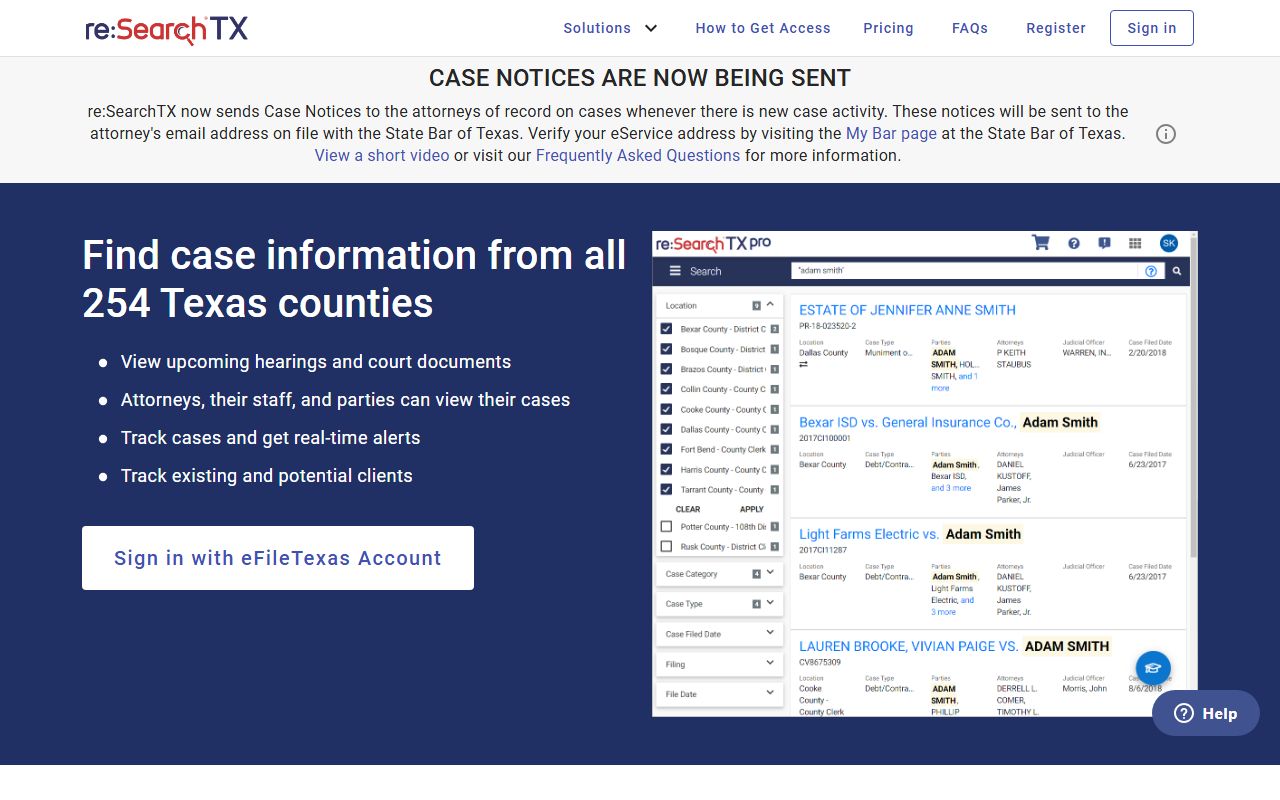
re:SearchTX is not a guarantee that every Parmer County case is online. It is one search channel among the clerk, prosecutor, and local court contacts.
Parmer County Prosecutor Records
The official District Attorney page identifies Jackie R. Claborn II as District Attorney and Michaela E. Kee as Assistant District Attorney. The DA page states that prosecutors represent the state in criminal cases, work with law enforcement in investigation and preparation, and decide whether prosecution should be instituted and pursued. It also explains the usual split that county attorneys represent misdemeanors while district attorneys represent felonies.
District Attorney
623 W. American Blvd.
Muleshoe, TX 79347
806-272-4205
Fax: 806-272-5558
The District Attorney page is useful because an arrest charge is not always the filed charge. Prosecutors may decline, amend, reduce, dismiss, or pursue a case based on the evidence and law.
Charging Documents After Arrest
Charging documents turn the post-arrest accusation into a court case. The exact document depends on the charge level and court path. A complaint may support an initial accusation. An information is commonly filed by a prosecutor. An indictment comes from a grand jury and is commonly tied to felony prosecution. The filed document matters more than the first jail-roster charge when reading court records after an arrest.
| Document | Who Uses It | What It Means |
|---|---|---|
| Complaint | Officer, prosecutor, or court process | A sworn accusation or charging basis used early in a case. |
| Information | Prosecutor | A formal prosecutor-filed charging document for a criminal case. |
| Indictment | Grand jury | A formal felony charging document returned by a grand jury. |
Parmer County Clerk Records
The District Clerk page says the district clerk keeps district-court records, records acts and proceedings of district court, enters judgments under the judge's direction, and maintains party indexes. The research identified the District Clerk phone as 806-481-3419 and fax as 806-481-9416. Because the extracted address line was incomplete, use the official district clerk page for current address details before mailing or visiting.
The County Clerk page identifies Susie Spring as County Clerk, with an office at 401 3rd Street, PO Box 356, Farwell, TX 79325, phone 806-481-3691, fax 806-481-9548, and hours Monday through Thursday 8:30am to 5:00pm and Friday 8:30am to 3:00pm. The county clerk serves as clerk of the county court and maintains official records of those courts.
Parmer County Charge Status
Charge status can change after a Parmer County arrest. A jail charge can be a booking label, while a court charge is the accusation filed and tracked in the case. A person may be booked on one description and later see the court file list a different wording, level, or disposition. That is why a court record search should check the clerk and prosecutor record, not just the roster.
| Status | What It Means |
|---|---|
| Pending | The charge is filed or active, and the court has not entered a final outcome. |
| Amended | The prosecutor or court changed the wording, level, or count from an earlier version. |
| Reduced | The charge moved to a lower level or lesser offense. |
| Dismissed | The court record shows the charge was dropped or ended without conviction. |
| Convicted | The case ended in a plea, verdict, or judgment of guilt. |
Bond After Parmer County Arrest
Texas bond law is mainly in Code of Criminal Procedure Chapter 17. After arrest, Article 15.17 requires a magistrate warning without unnecessary delay, and bail may be addressed. Parmer County pages did not publish a bond desk schedule, accepted bond payment methods, or bond schedule. Confirm current bond and release eligibility with the jail or court before acting.
| Bond Type | How It Works |
|---|---|
| Cash bond | Money is posted directly as required by local court or jail practice. |
| Surety bond | A licensed bondsman posts bond under Texas law and local acceptance rules. |
| Personal or PR bond | Release is based on a promise to appear, often with court conditions. |
| No-bond hold | A charge, warrant, parole hold, federal hold, ICE detainer, or court order blocks release. |
Warrants and Arrest Records
No official Parmer County Sheriff active-warrant search page was located in the reviewed county pages. A warrant can still lead to a jail booking, and the roster or charges grid may show a warrant-related description after arrest. Absence from the roster does not prove that no warrant exists. The right channel depends on the issuing court.
- Bench warrant
- A court-issued warrant, often after failure to appear or failure to comply.
- Capias
- A court order for arrest after a court action, judgment, or noncompliance.
- Detainer
- A request or hold from another agency that can affect release.
For warrant-related questions, use the sheriff or jail phone at 806-481-3303, the District Clerk, the County Clerk, Justice of the Peace channels, or an attorney before appearing at a law-enforcement office.
Charges vs Convictions
An arrest and charge are accusations. A conviction is a final court outcome based on a plea, verdict, or judgment. The Texas DPS Criminal History Conviction Name Search is a statewide conviction-history channel, but it does not replace the local clerk's court file and does not show every pending arrest.
| Issue | Charge | Conviction |
|---|---|---|
| Stage | Accusation after arrest or filing | Final judgment, plea, or verdict |
| Source | Jail roster, prosecutor filing, clerk docket | Court judgment and conviction-history systems |
| Can change | Yes, charges may be amended or dismissed | Changes only through appeal, order, expunction, or other legal process |
Sealed and Expunged Records
Texas expunction law is in Code of Criminal Procedure Chapter 55. Expunction can remove eligible arrest and case records from public access. Nondisclosure is different. It limits public access to some criminal history but does not treat every record as though it never existed. Eligibility depends on the outcome, charge, time period, and court order.
| Issue | Nondisclosure or Sealing | Expunction |
|---|---|---|
| Effect | Limits public access to eligible records | Can remove eligible records from public access and require agencies to comply with the order |
| Common trigger | Some eligible dispositions under Texas law | Dismissal, acquittal, or other eligible outcome under Chapter 55 |
| Next step | Review the court order and clerk record | Confirm the expunction order with the originating court and agencies |
Important: Public lookup information is not a consumer report and must not be used for FCRA-covered screening decisions.